Showing posts with label Continual Improvement. Show all posts

Tuesday, February 25, 2014

Grading: Two Thoughts

We started a new unit and there hasn't been much to grade.  I am itching to know what the students know.

Grading papers helps me in two ways.  First, it gives me an opportunity to see what the students are learning and, secondly, it's another way to communicate with students.  Grading 186 papers is difficult work, but thinking about these two things keeps the grading engaging.


What do You Know?

I have determined that informing students to the purpose of an assignment helps them produce work that is complete and thorough.  Over the past two weeks I have stressed that assignments are a tool for me to know what you know; if you don't write it down, I don't know that you know the material.

Over the course of grading I can find weaknesses in the students' understandings and address them the next day.  I can also see where the students are excelling or what topics interest them the most.  Knowing students' strengths and weaknesses helps drive future instruction.

Communication

Grading is also a time to communicate back to students.  It takes a bit longer, but I want to make comments that will help students.  Even if I don't mark points off, I want them to know how they can do better work.  I may refine my ideas on grading, but it seems like the students deserve thoughtful comments on things they spent significant time on.  Unless students are given time to research stuff they got wrong, checks and "-1" next to answers doesn't communicate much to a student.


Today is a good day.  Students are turning in their first assignments and I am looking forward to grading them.

Wednesday, February 19, 2014

Teaching First: Project Worksheet

Well, here it is.  My first Project Worksheet (pdf)!

I adapted it from several sources to meet the needs of the our classroom.  Teachers, please note the appealing lack of Comic Sans.  I used Arial, a font for grown-ups.
The method of the project I found at the University of Georgia website.  Click here to look at the entire packet; it was created for a much more extensive project that includes a 10-15 minute presentation.
I also took the rubric method from a book on grading from Robert Marzano.

I'm sad that I have to send it to the district copier.  In a perfect world I would make the project worksheet available online and the students could refer to it electronically and print it out themselves only if they wanted a hard-copy.

This will accompany a poster the students will use as a model when I present the project.  This helped keep the worksheet to one page.

I'm really looking forward to the student's response to the worksheet.  I'm sure there will be a version 2 to stick in my electronic filing cabinet to pull out and adapt for next time.  The biome projects should be pretty good.  My students have proved themselves to be rather creative.

Here's how I created the published PDF worksheet


  1. Create document in Microsoft Word
  2. Save as PDF
  3. Upload to Google Drive
  4. Find document in Google Drive, select it, and then hit share.  Under the "Who has access" section, click on the "Change" link.
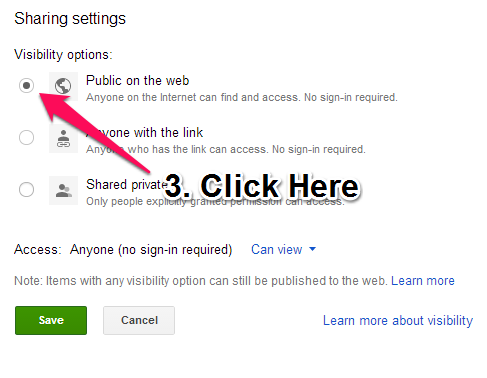
  5. Click on the "Public on the web" radio button, then click "Save."
  6. Distribute the resulting link.  Copy and paste it into your favorite electronic platform.

    I would use the Google URL Shortner to make communication easier.  Bitly also works nicely.
    See the Wikipedia article on URL Shortening here:  URL Shortening
  7. Resolve to print fewer pieces of paper.

Wednesday, February 12, 2014

The Most Dangerous Phrase

The most dangerous phrase a person can say is, "We've always done it that way."

Today the students will sit down to an exam that has been given to students since the 90's.  The review worksheet is a copy of a copy of a copy and only mostly legible.  The multiple choice part of the exam has been literally cut and pasted together before being sent to the copy center.


I have been rather surprised at the lack of reflection from a lot of seasoned teachers.  When students do poorly on an assessment, teachers are quick to say, "Well, they just need to study more."  This may be the case, but conversation about reevaluating a quiz or ensuring the material delivered in class match questions on a quiz has been anathema.

Naturally, students are scared of exams.  Some do well and some do poorly.  The part that concerns me is that students are surprised.  Even worse, teachers are surprised.  If assessments given during a unit are well-planned, and if the teacher has done a good job communicating with the students, the results of a unit exam or other summative assessment should not be a surprise.

Fear and poor grades kill a students' interest in a subject.  If we're serious about our subject, we must improve on the things we've always done.

Here are a few ideas I have now:
  1. Rewrite test questions that students repetitively ask about.  
  2. Develop instructional plans directly from the summative assessment.  
  3. Teach test-taking skills during the unit.
  4. Analyze common mistakes on formative assessments and make sure to change future instruction.
  5. Ensure questions accurately assess what you want the students to know.  
  6. Heavily comment on formative assessments.  Communication, though it takes a lot of time, is something the students deserve.
  7. Do a review of an assessment after the quiz or test with the students.  All assessments should help students understand the content.
  8. Do an evaluation of all assessments, making sure the assessment was an accurate portrayal of students' understanding.  If not, change something.  
That's a lot, but making improvements, even small ones, has the potential to increase student understanding.  That's what we're here for, right?